

Representing Robbins College on an International Stage
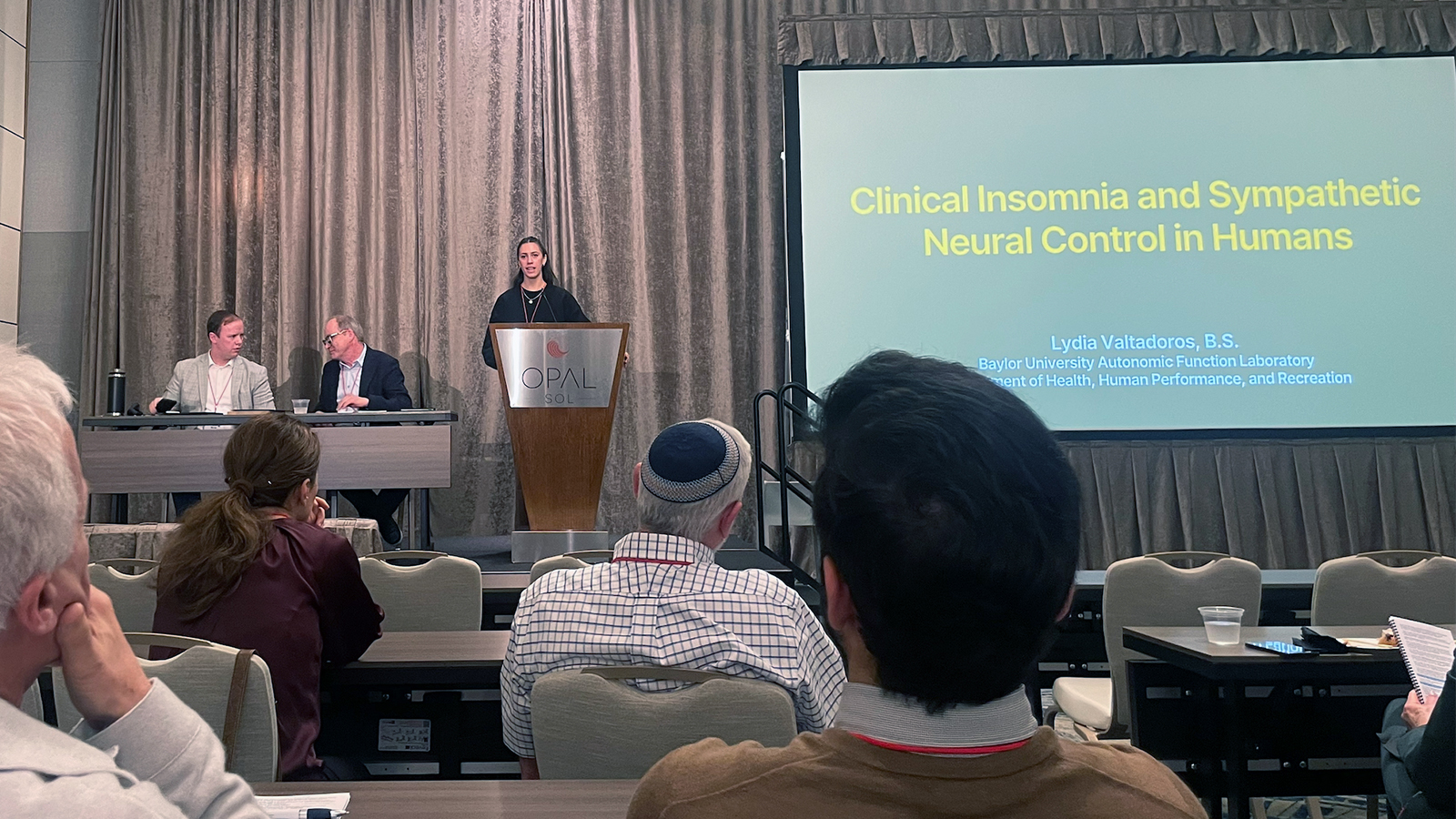
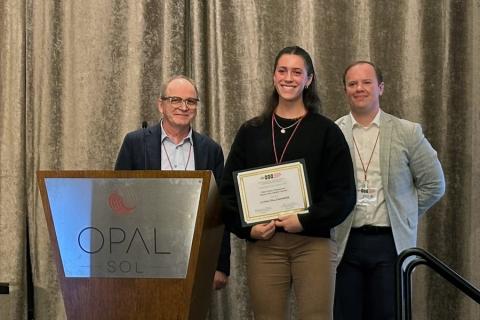
Baylor University graduate student Lydia Valtadoros recently accepted a prestigious award—the FMS/Peňáz Wesseling Travel Fellowship Award—for her abstract submission to the 2025 International Symposium on the Autonomic Nervous System. As part of the honors, the American Autonomic Society invited her to attend and present her findings at the conference in Clearwater Beach, Florida.
Valtadoros' presentation, titled "Clinical Insomnia and Sympathetic Neural Control in Humans," outlined her investigation into sympathetic nervous system regulation and cardiovascular control in humans with diagnosed clinical insomnia using high-fidelity techniques such as microneurography and beat-to-beat blood pressure monitoring. The study incorporated previous and ongoing data collection by the Autonomic Function Laboratory team at Baylor, led by Robbins College of Health and Human Sciences Dean Jason R. Carter, PhD, Assistant Research Scientist Jeremy Bigalke, PhD, and Lab Technician Jennifer Bigalke.
"National and international conferences are great opportunities for graduate students to not only gain necessary research presentation experience, but also to develop lasting collaborative networks that will support their future growth as independent scientists or clinicians," Jeremy Bigalke said. "Lydia did a phenomenal job with her abstract and presentation, and to receive an award from an international research symposium is a huge testament to all her hard work and dedication in the lab."
In the Lab
"We're a human research lab," said Valtadoros, who is pursuing a Master of Science in Exercise Physiology at Baylor. "Basically, we have people come in and then we stress them out to see how their body responds."
Each study measures similar parts of a person's physiology—sympathetic nervous system activity, heart rate, blood pressure, and respiratory rate—but the stimuli differ in each. For this project, Valtadoros recorded how the sympathetic nervous system, which regulates blood pressure and heart rate, was affected by clinically-diagnosed insomnia. The Autonomic Function Laboratory used a relatively rare technique called microneurography, which utilizes a fine microelectrode to directly measure peripheral sympathetic activity in humans. Participants were measured at rest and during a cold pressor test, where their hand is placed in ice water for one to two minutes, causing a reliable stress response that increases sympathetic activity, blood pressure, and heart rate.
Valtadoros hypothesized that individuals with clinical insomnia would demonstrate impaired sympathetic-cardiovascular regulation compared to healthy controls, highlighting a potential mechanism underlying the association between clinical insomnia and cardiovascular risk. Her findings offered novel insight regarding impaired baroreflex regulation of blood pressure as one such potential mechanism, despite unchanged sympathetic-vascular coupling. Baroreflex is one of the body's mechanisms that helps maintain blood pressure at a constant level.
For her own oral presentation, Valtadoros remembers being both excited and nervous to represent Baylor and Robbins College. Ultimately, she realized the opportunity reflected the commitment and support of the faculty and organizations invested in her success.
"I felt so prepared because I had practiced a lot with Dr. Bigalke and Dean Carter. Even the night before, Dean Carter asked me if I wanted run through the presentation one more time," Valtadoros said. "As someone who has been enrolled in Robbins College for less than a semester, I've noticed that the professors here really want the students to succeed, and everyone in the community is so nice and supportive—it's such a great place."
And, as a proud Baylor Bear, Valtadoros made certain her presentation’s final slide read, "Thank You. Sic 'Em."
ABOUT ROBBINS COLLEGE OF HEALTH AND HUMAN SCIENCES AT BAYLOR UNIVERSITY
Established in 2014, Robbins College of Health and Human Sciences seeks to enhance health, quality of life, and human flourishing for all individuals and communities through education, research, and innovation. It includes seven academic departments—Communication Sciences and Disorders; Health, Human Performance, and Recreation; Human Sciences and Design; Occupational Therapy; Physical Therapy; Physician Assistant Studies; and Public Health. Robbins College offers 13 bachelor’s degrees, 10 master’s degrees, and six doctoral degrees, as well as nine graduate programs in partnership with the U.S. Army. Graduate programs in Robbins College are offered in a variety of modalities, including on campus, online, and hybrid.