

Training Ground for Future Health Professionals
Baylor University’s new Clinical Simulation & Skills Facility offers graduate health professional students a state-of-the-art learning environment
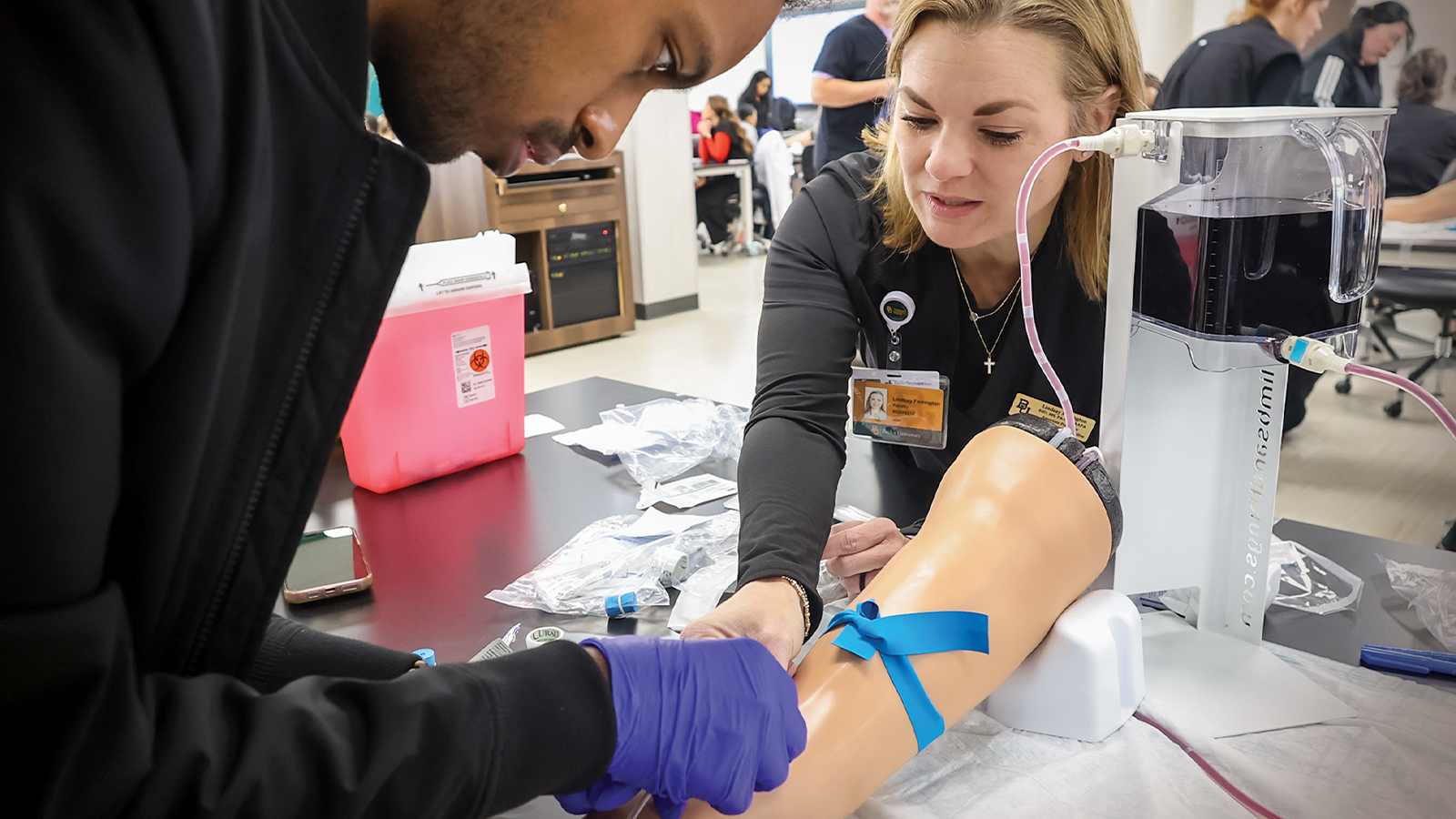
Physician Assistant Studies student Yonatan Kidane (left) and Clinical Associate Professor Lindsay S. Ferrington (right)
In Robbins College of Health and Human Sciences, one of the key components of hybrid graduate programs—including Physician Assistant Studies, Physical Therapy, and Occupational Therapy—is the on-campus immersion sessions that occur throughout the program. During these visits to Waco that range from a few days to a couple of weeks, students put their online learning into practice. With packed daily schedules and a focused curriculum, students are engaged in skill development, applied learning, and rigorous exams throughout the session.
Immersions are critical to a successful hybrid education experience because they encapsulate the students’ hands-on preparation before beginning clinical rotations. Faculty travel in from across the country to lead the classes alongside adjunct instructors boasting specialty expertise to further enhance student readiness.
In October 2025, Robbins College opened the doors to a state-of-the-art facility designed to take the in-person immersion experience to a new level. The Clinical Simulation & Skills Facility, located on the fourth floor of Cashion Academic Center, is the first of its kind on the Baylor campus. Informed by faculty and practitioner expertise and experience, this new facility is first-class when it comes to clinical education.
Featuring medical-grade equipment, modern patient rooms, and advanced technology, the facility replicates the aesthetic of contemporary healthcare design. It offers students in graduate health professional programs the opportunity to immerse themselves in a realistic medical setting where they can practice skills safely and effectively.
Quality and intentionality are threaded through every component of the Clinical Simulation & Skills Facility—from steel beams that accommodate medical-grade emergency room lights to hospital push sinks to multifunctional instructional debriefing rooms. Understanding the medical field’s propensity for rapid change, the facility is also designed with flexibility and functionality in mind.
The Clinical Simulation & Skills Facility represents an investment by the University into the training of future healthcare leaders. By integrating cutting-edge instructional technology within replicated real-world medical settings, Robbins College is creating space for students to develop competence and confidence that will further enhance their readiness to enter the healthcare field and make a difference for their communities, and the world.
Skills Lab
The largest space in the Clinical Simulation & Skills Facility, the skills lab is designed to hold an entire cohort of graduate students for large-group instruction. Adjustable tables often fill this highly flexible space where students might practice suturing, constructing braces, or practicing blood draws.
Trauma Suite
Outfitted with medical-grade equipment, students in the trauma simulation suite interact with a high-fidelity manikin to provide emergency care in a controlled setting. From stroke and cardiac arrest to hemorrhage control, students practice responding to high-stress medical scenarios using real clinical tools and equipment.
Simulation Suites
The Clinical Simulation & Skills Facility includes simulation suites, designed to replicate hospital patient rooms and primary care exam rooms, that can accommodate both high-fidelity manikins and standardized patients (trained individuals simulating patients). Diagnostic equipment, working IV systems, and advanced audio-visual capabilities offer students a realistic medical environment to practice patient interactions.
Labor and Delivery Suite
The labor and delivery simulation suite houses a birthing bed and newborn bassinet, along with a high-fidelity maternal/birthing manikin and newborn manikin. Providing the highest level of obstetric training, students engaging in the labor and delivery suite are trained to respond to scenarios ranging from low-risk birth to complex obstetric emergencies.
Student Lounge
In addition to the clinical training spaces, it is imperative that students have a space to remove their gloves, grab a bite to eat, and engage with their peers. The student lounge is designed as a relaxing, collaborative space with large windows to let the sunlight in.
High-Fidelity Manikins
Lifelike manikins give students the opportunity to immerse themselves in real-world medical situations while still learning their professional skills. These highly advanced simulators utilize artificial intelligence and advanced technology to present a wide range of scenarios to which students must respond.
Control Room
The Clinical Simulation & Skills Facility utilizes the latest in audio/visual and simulation technology to create a high-functioning, adaptable educational experience for students. From programming manikin scenarios to providing remote instructor guidance during simulations, faculty, staff, and students remain virtually connected throughout each educational experience.
Briefing Rooms
Multifunctional briefing rooms optimize the learning experience for students and faculty. With two-way mirrors placed between briefing rooms, students and faculty can observe training experiences, provide feedback, and learn alongside one another in a collaborative setting.
ABOUT ROBBINS COLLEGE OF HEALTH AND HUMAN SCIENCES AT BAYLOR UNIVERSITY
Established in 2014, Robbins College of Health and Human Sciences seeks to enhance health, quality of life, and human flourishing for all individuals and communities through education, research, and innovation. It includes seven academic departments—Communication Sciences and Disorders; Health, Human Performance, and Recreation; Human Sciences and Design; Occupational Therapy; Physical Therapy; Physician Assistant Studies; and Public Health. Robbins College offers 13 bachelor’s degrees, 10 master’s degrees, and six doctoral degrees, as well as nine graduate programs in partnership with the U.S. Army. Graduate programs in Robbins College are offered in a variety of modalities, including on campus, online, and hybrid.