

A Survivor’s Inspiration
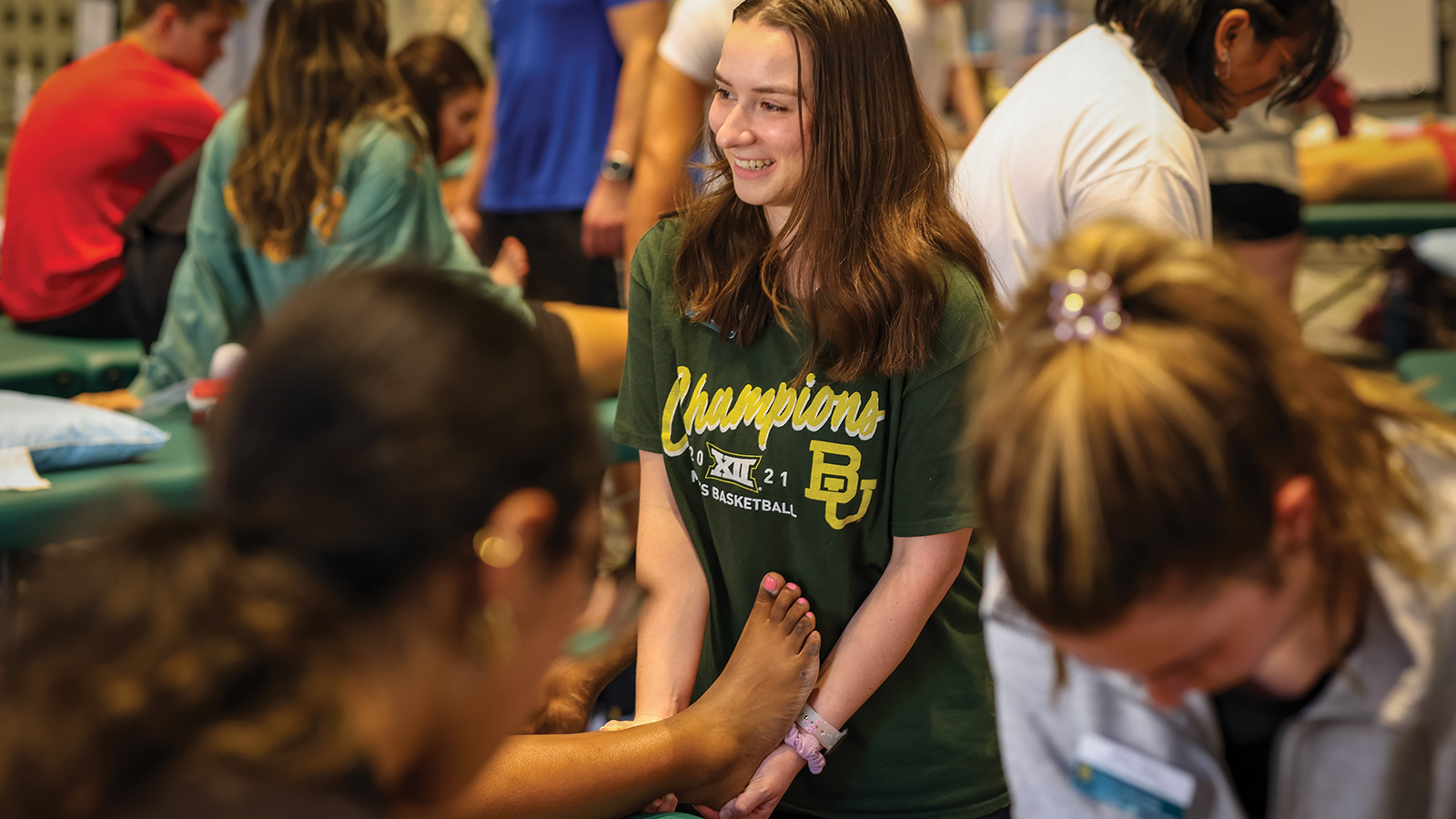
Physical Therapy doctoral student Peyton Gill
When Peyton Gill was 14 years old, she was involved in dance, a member of her school’s pep squad, and trying to earn a good grade in freshman biology lab. Certainly, she never imagined she would also begin a fight to survive Stage 4 ovarian cancer. Now 23 years old as a second-year Doctor of Physical Therapy (DPT) student at Baylor University, she looks back on those years with gratitude.
“Unfortunately, with ovarian cancer, the signs and symptoms are very vague,” she said. “They’re kind of just normal things any woman might experience—fatigue, cramping, abnormal menstruation cycling, bowel changes, stuff like that.”
Often referred to as a “silent killer,” ovarian cancer symptoms tend to be misdiagnosed or go unnoticed until they become severe. According to the National Cancer Institute, just one in five individuals are diagnosed at Stage 1, while 55% of individuals are diagnosed after the cancer has spread to a different part of the body.
Admitted to the Hospital on a Wednesday
Some days Gill could barely get through dance practice before collapsing into bed. Pain would come in waves and then disappear for days. After several visits to her pediatrician, an ultrasound and bloodwork uncovered what no one imagined: a 13-pound tumor the size of a basketball in her abdomen.
“It’s strange, I was happy when I got called out of school because I had been so fatigued this whole time. As luck had it, I was called out of biology lab,” she remembered. “My parents broke the news on the drive to the hospital.”
Gill and her family met with an oncologist and she was immediately admitted.
“My oncologist, who is one of my best friends now, is really awesome,” she said. “I’m very grateful that he was on call that day because you don’t always get to pick who will save you.”
The next day, Gill had surgery to remove the tumor. Recovery was fuzzy, but something bright emerged: her first encounter with physical therapy.
Because the surgery required cutting through abdominal muscles, Gill needed help to get moving again. This self-proclaimed “lazy girl,” who still to this day enjoys resting, soaked up her physical therapist’s encouragement.
“My physical therapist was one of the highlights of my journey,” she recalled. “He made everything so fun. I would always be like, ‘Oh, I don’t want to get up.’ And he’d respond, ‘Gotta do it, Peyton.’ He was really encouraging to get me up and moving—to get me better sooner, so I could go home.”
Although surgeons had successfully removed the entire tumor, they found cancer spread throughout Gill’s abdominal cavity. Thus, she underwent eight rounds of chemotherapy, as well as many transfusions, with treatment stretching across an entire year.
“Obviously, everyone’s journey is their own. But comparatively, my journey was—I was very lucky,” she stated. “But chemo sure hits you hard. Both your body and your mind.”
To allow her weakened immune system time to recover between treatments, Gill completed her sophomore year of high school from home. It was during this time she built skills that she credits for her independence as a doctoral student today.
In November 2018, good news finally came. Gill was declared cancer-free.
A Purposeful Life
Being an ovarian cancer survivor isn’t something Gill hides. She wants individuals to learn the symptoms and to not give up when initial labs suggest normalcy. This September, she introduced National Ovarian Cancer Awareness Month and Childhood Cancer Awareness Month to her Baylor DPT cohort.
“As a pediatric patient, I got so much support from organizations like American Cancer Society, National Ovarian Cancer Coalition, and Make-A-Wish,” she said. “So, I volunteer and I tell my story a lot—I’m on the other side now, luckily.”
This even led to one of the brightest parts of her life: her dog, Riplee, gifted to her at a cancer-awareness event.
“He’s my little reward for surviving,” she joked.
Gill was drawn to Baylor’s DPT program for its flexibility and its emphasis on connection, community, and evidence-based care. The hybrid design allows her to stay in San Antonio, Texas, close to her family and support groups.
“Baylor’s values really speak to me,” she said. “At the end of the day, you’re not treating a knee, you’re treating a person. A patient’s not going to get better if you’re just hyper focused on one body part. It’s important to bring it back around and truly see this person—they might have a bunch of other things going on with their body, with their mind, with their environment, and their family.”
Gill is not yet certain which physical therapy specialty she’ll pursue. While pediatrics tugs at her heart, she’s also fascinated to work with neurological and geriatric patients.
“I just love everything,” she admitted. “Baylor’s required clinical experiences next year will help me discover where I fit in.”
What she does know is that her experience as a patient will shape her future as a clinician. One focus will be to shift the perspective of those who are discouraged by chronic pain and long recovery timelines.
“My journey taught me a lot of patience,” she shared. “I don’t remember all of the exercises I did, but I do remember that my physical therapist always came into my room with a smile on his face. Hospitals aren’t fun. Yes, the pediatric wing was a little more fun and colorful, but as a whole, it’s not the place you want to be. I remember how he made me feel, that stuck with me.”
It has been nearly a decade since her diagnosis, but the impact lingers. Gill chooses to carry with her the lesson she learned at 14 years old: healing is never just physical. It is connection, patience, resilience, and a smile on a hard day.
ABOUT ROBBINS COLLEGE OF HEALTH AND HUMAN SCIENCES AT BAYLOR UNIVERSITY
Established in 2014, Robbins College of Health and Human Sciences seeks to enhance health, quality of life, and human flourishing for all individuals and communities through education, research, and innovation. It includes seven academic departments—Communication Sciences and Disorders; Health, Human Performance, and Recreation; Human Sciences and Design; Occupational Therapy; Physical Therapy; Physician Assistant Studies; and Public Health. Robbins College offers 13 bachelor’s degrees, 10 master’s degrees, and six doctoral degrees, as well as nine graduate programs in partnership with the U.S. Army. Graduate programs in Robbins College are offered in a variety of modalities, including on campus, online, and hybrid.