

Leading the World in Oncologic Speech-Language Pathology
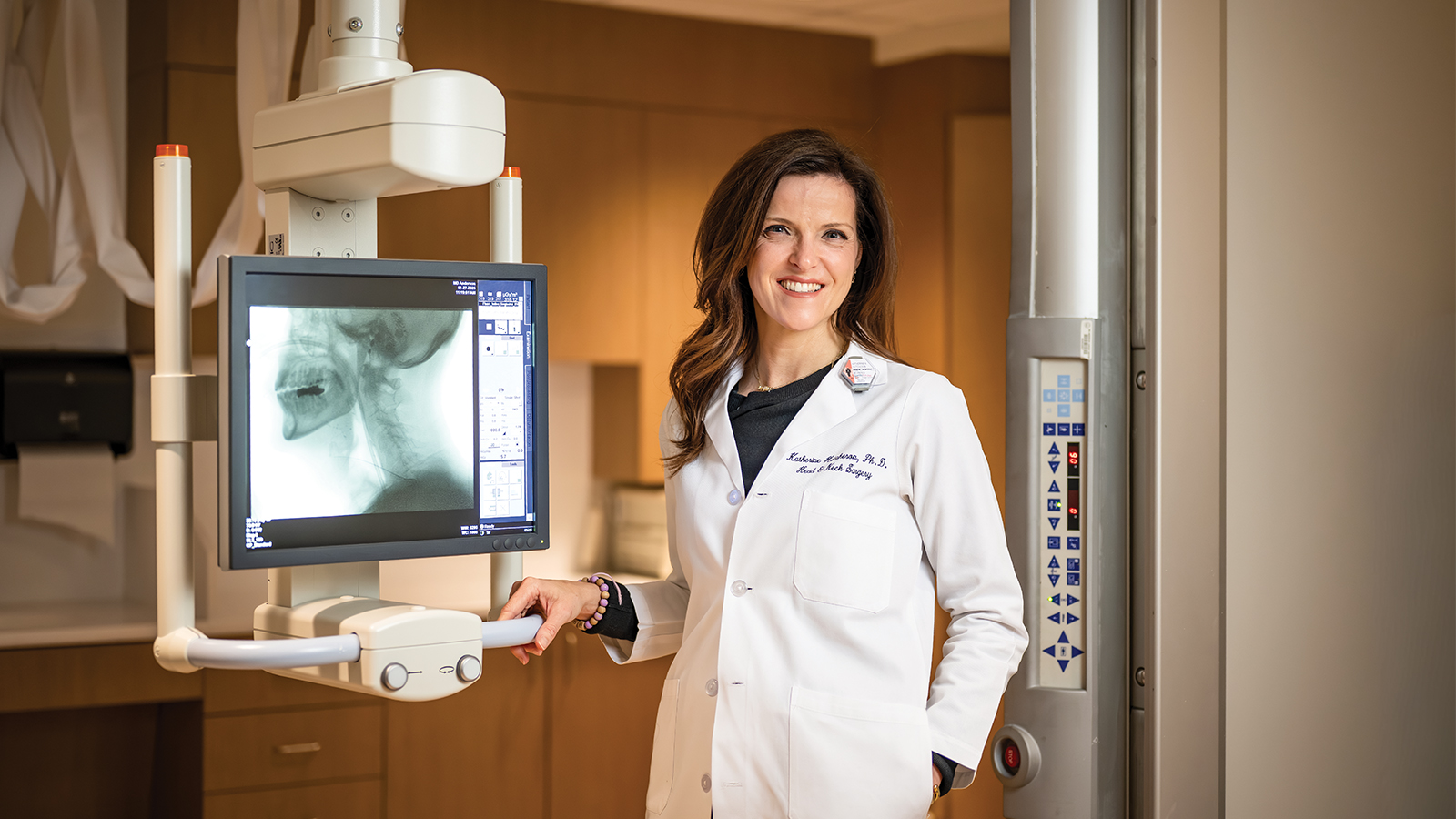
Katherine A. Hutcheson, Speech-Language Pathology alumna
Photo courtesy of the University of Texas MD Anderson Cancer Center
Katherine A. Hutcheson, PhD, BCS-S, SLP-CCC, is a nationally known expert in head and neck cancer dysphagia. Along with being an accomplished educator, clinician, and research scientist, she also is a Baylor University alumna. While Hutcheson graduated with both her Bachelor of Arts and Master of Science degrees from the Department of Communication Sciences and Disorders (CSD), she initially didn’t come to Baylor to be a speech-language pathologist. Originally, she was a theatre arts major.
“I come from an artistic family and loved performing, but I realized quickly I didn’t want to pursue it professionally,” she shared. “So, I went non-degree—until I talked to a family friend who was a speech-language pathologist and involved in musical theatre with my mom. Then, I decided to work with the voice, but in a clinical space.”
Finding Her Calling
People who use their voice professionally sometimes require voice care from a speech-language pathologist. When Hutcheson started her graduate journey, she thought she would follow that professional path. Yet, as she progressed through CSD’s program, one of her professors at the time, David Garrett, PhD, noticed her talents. He encouraged her to apply for a competitive internship in speech pathology of cancer at the University of Texas MD Anderson Cancer Center in Houston, Texas.
“When I interviewed at MD Anderson, I remember saying that I didn’t really like the swallowing aspect of speech pathology. This was wrong, of course, but I didn’t know it at the time,” she said. “I love that part of the field and have focused most of my career in this space. Reflecting, I am reminded that my pathway to and through oncologic speech-language pathology was not linear, but I got where I am today by following each opportunity in front of me.”
Today, Hutcheson works at MD Anderson as a tenured Professor in the Department of Head and Neck Surgery, where she is Section Chief of Speech Pathology and Audiology and directs a world-recognized research program. She is most known for her research on head and neck cancer survivorship and dysphagia. As a speech-language pathologist, she focuses on two core survivorship areas: communication abilities and eating abilities.
Pioneering Research
Hutcheson’s research at the Hutcheson Laboratory at MD Anderson has led to innovative discoveries that have benefited patient care globally. The lab developed a methodology tool called DIGEST, which helps clinicians grade the results of an X-ray swallowing study—and in just one decade, DIGEST has become a leading tool in the field. Hutcheson’s lab was also the first to identify and characterize the clinical phenomenon of late dysphagia that develops years or decades after radiation-based treatment.
Today, the Hutcheson Laboratory is utilizing grant awards from the National Cancer Institute to examine late side effects of treatment, with the goal of finding non-invasive, simple ways to identify problems earlier—when they’re more treatable. Similar to prehabilitation, the preparation before a treatment, prohabilitation is a term Hutcheson uses to describe her vision to help survivors proactively stay ahead of the long-term side effects of treatment after cancer.
“In the second decade after beating cancer, around 10% of survivors who were cured by radiation develop crippling late side effects. For example, they might lose the ability to eat and speak after slowly accumulating radiation injury,” she explained. “When I started my career, it was common practice for all patients to use a feeding tube to get through radiation and then worry about their functions later. Now, we’ve shifted to keeping functions active, so they’re not lost.”
This mindset is now routine during head and neck cancer treatment, due in part to pioneering research like Hutcheson’s PRO-ACTIVE trial. Her goal is to bring this same mindset to the later years of cancer care.
For example, in cases of cancer treatment that require a laryngectomy, the surgical procedure to remove a person’s voice box, Hutcheson helps with prosthetic voice restoration—to give voice back after it is completely lost to cancer. Alongside industry partners, she develops clinical trials to study different prosthetics that can restore the voice. In one new collaboration, artificial intelligence-facilitated tools are being used to restore a patient’s preoperative voice.
“This would be the most transformative project I have ever worked on in my career,” she shared.
The key to combatting cancer side effects is creating a personalized treatment that, as Hutcheson stated, “optimizes the quality of life of the person right in front of you—whatever that means to them.” Each patient determines their own priorities for rehabilitation because although they may be dealing with the same problem, two patients often need completely different approaches.
“One of the realities is that you can’t always fix the situation,” she said. “While cancer is ultimately out of our control, we get to help a patient or their family navigate how to make them most comfortable. We are daily given the opportunity to see people’s resilience and their faith. This is why I love seeing patients—it brings me a lot of joy and purpose.”
Lasting Influences
Although Hutcheson did not come to Baylor knowing that she would practice oncologic speech-language pathology, she does believe that the University creates a natural environment for a future that is service-oriented. Students often approach career paths through the lens of their faith and stewardship, which can be ideal for professions in fields such as education and healthcare.
“Baylor has a servant leadership model that is unique to see in the academic environment,” she said. “It teaches us to embrace our humanity.”
In the last few years, Hutcheson has accepted opportunities to return to Baylor CSD to share her research with future clinicians.
“It’s amazing to come home and see how far the programs have come. The clinical spaces are phenomenal,” she said. “It’s a place I’m really proud to be from. The fundamentals of clinical care that we were taught are still present in my day-to-day practice—the training never leaves you.”
ABOUT ROBBINS COLLEGE OF HEALTH AND HUMAN SCIENCES AT BAYLOR UNIVERSITY
Established in 2014, Robbins College of Health and Human Sciences seeks to enhance health, quality of life, and human flourishing for all individuals and communities through education, research, and innovation. It includes seven academic departments—Communication Sciences and Disorders; Health, Human Performance, and Recreation; Human Sciences and Design; Occupational Therapy; Physical Therapy; Physician Assistant Studies; and Public Health. Robbins College offers 13 bachelor’s degrees, 10 master’s degrees, and six doctoral degrees, as well as nine graduate programs in partnership with the U.S. Army. Graduate programs in Robbins College are offered in a variety of modalities, including on campus, online, and hybrid.