

Baylor Interior Design Researcher Provides Key Wildfire Safety Insights
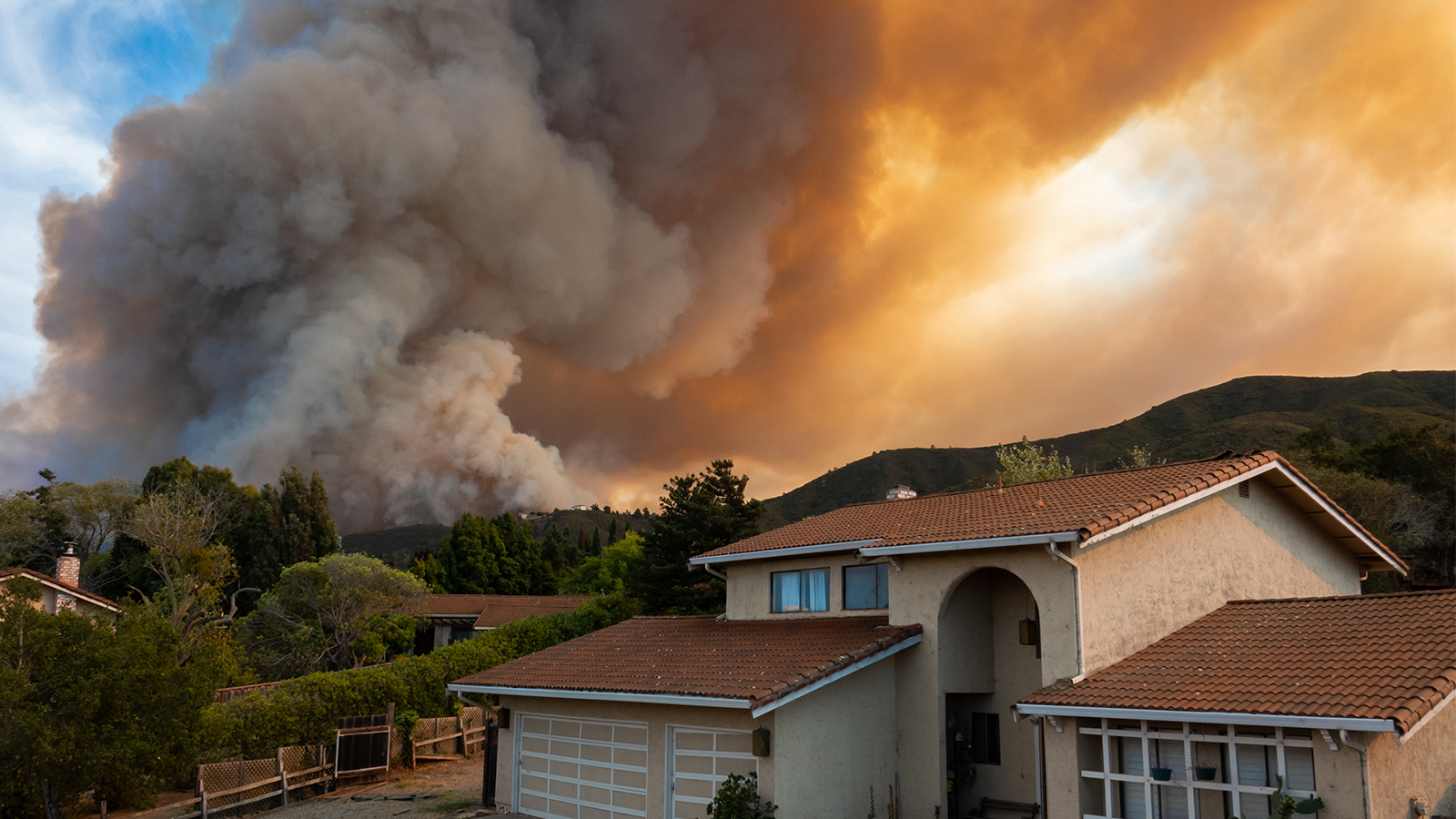
Wildfire approaches a neighborhood built along a wildland–urban interface (WUI).
“Fire season does not exist anymore, so you need to be prepared at all times, no matter where you live. A lot of this information already exists, but the challenge is making sure people can find it—and use it—when it matters most.” —Debra Harris, PhD
As environmental challenges amplify wildfires to grow more frequent and more destructive, the lines between rural and urban danger have begun to blur. Much of that shift is driven by what experts call the wildland–urban interface (WUI)—the places where forests, deserts, meadows, and other undeveloped lands meet populated suburbs and cities. These zones have become a defining feature of modern fire risk.
According to the United States Fire Administration, the WUI zone grows by approximately 2 million acres each year. Currently, the U.S. has more than 60,000 communities at risk, with California, Texas, Florida, North Carolina, and Pennsylvania as the top five states with the greatest number of homes in the WUI.

“It’s been a game changer in terms of fire safety,” Debra Harris, PhD, Professor of Interior Design at Baylor University, said. “Unlike traditional structure fires, which tend to follow predictable patterns based on building materials and contents, we now experience devastating wildfires along the WUI that bring a different profile entirely and the risks compound.”
In addition to emotional, monetary, and physical damages, wildfires cause widespread public health risks. For example, smoke and ash can worsen respiratory conditions, increase cardiovascular events, and trigger eye and skin irritations. In areas scorched by heat and flames, soil and water sources can become contaminated.
Harris stresses that there are cost-effective actions individuals can take to help mitigate exposure risk, as well as important steps to take during post-fire cleanup.
She facilitated a national taskforce, assembled and published by Underwriters Laboratories Research Institute’s Chemical Insights, to create a “guidance toolkit” that provides practical help individuals can reference for such steps. This multidisciplinary taskforce brought together experts in built environments, chemical and water exposure, fire safety, insurance, and public health, along with government officials and professionals from universities and academic organizations.
“If you’re in a house and there’s a fire nearby, what can you do to prepare for the fire if you’re in that zone? What can you do during a fire? And what can you do after a fire?” Harris posed. “The resources in this toolkit can assist you on that journey.”
Below, she shares key insights and safety tips for what to do before, during, and after an affecting wildfire.
Pack Your Go-Bag
Initial preparedness includes packing a comprehensive go-bag—something you can quickly grab if an emergency is nearby. Make certain to include items such as:
- Important legal documents and cash
- Food, water, medications, and pet supplies
- Emergency contact information
- Personal protective equipment, hygiene items, and first aid
- Generator fuel, vehicles, tools, and sanitation supplies
Smoke Travels Far
Exposure to harmful smoke and ash is not limited to communities near a wildfire. Instead, smoke can affect people within miles, across regions, and even cross state and national borders:
- Immediate exposure occurs within 6 miles
- Regional exposure can reach up to 600 miles
- Continental exposure exceeds beyond 600 miles
“Someone in Colorado could be affected by a fire in Oregon. We’ve experienced smoke that made its way to New York from Canadian fires,” Harris said. “You can’t draw the line at a border—smoke has a far reach.”
It is important to know that what people see drifting across the sky is not just haze. It is a complex mix of particles and toxic chemicals, and sometimes, the chemicals change and become more hazardous as extreme heat intensifies.
Check Local Air Quality
The Air Quality Index (AQI) is a public tool individuals can utilize to understand immediate outdoor air quality. AQI levels—illustrated with six color-coded categories and corresponding index values—indicate when to take no action, prepare, or actively manage smoke exposure.
“You can download the app, or your weather app may have this information integrated in,” Harris said. “Either way, it’s a great reference. It’s not just related to fires but related to anything that’s happening in terms of weather conditions.”
Reduce Indoor Exposure
For inside the home, renters and homeowners alike can take practical steps to mitigate risks by following layered strategies. In some cases, individuals can make affordable adjustments to existing equipment. Actionable steps to keep air quality safe during potential exposure include:
- Tightly close all windows and doors
- Create a designated “clean room” with protected air
- Install proper MERV 13 filtration for whole-house HVAC system
- Use portable air cleaners that have HEPA and charcoal filters
- Build low-cost DIY air cleaners
“Importantly, our toolkit talks about a do-it-yourself air cleaner. A lot of people on the West Coast don’t have a HVAC system, or you may not want to spend $100 for a portable one,” Harris explained. “All you’d need to do is pick up an inexpensive but quality filter, and then follow our instructions to use duct tape, a portable fan, and the filter to circulate clean air into the space.”
Post-Fire Cleanup
After a wildfire, all surfaces can be contaminated with toxic chemicals. Due to this, it’s important to understand that families (including farm animals and pets!) can’t simply return home and resume normal routines without cleaning and mitigation. Harris says there are tasks an individual can do on their own, while more granular tasks will need the help of professionals. Some considerations are to:
- Wear personal protective equipment, such as N95 or P100 masks, goggles, and latex or nitrile gloves
- Keep pets safe by having them wear booties and washing their paws
- Prevent recontamination from outside to inside
- Test indoor air and surface contamination
- Clean using HEPA vacuums and microfiber cloths
- Carefully research mitigation companies to avoid being overcharged
- Clean outdoor soil contamination
“Post-fire can be a stressful time, so even seemingly basic guidance becomes essential—there is a comprehensive checklist homeowners can follow to regain control of the situation,” Harris said. “Importantly, we provide explicit information on how to work with mitigation companies—the professionals hired to decontaminate homes and properties—so individuals understand how to avoid unnecessary costs and manage the entire process effectively and with confidence.”
Learn more about what you can do before, during, and after a fire by reading the taskforce’s resources:
Clearing the Air on Wildfire Smoke: A Toolkit for Reducing Downwind Exposure Risks
Guidance and Practical Strategies for Reducing Public Health Impacts of Wildland-Urban Interface (WUI) Fires on Community Populations
ABOUT ROBBINS COLLEGE OF HEALTH AND HUMAN SCIENCES AT BAYLOR UNIVERSITY
Established in 2014, Robbins College of Health and Human Sciences seeks to enhance health, quality of life, and human flourishing for all individuals and communities through education, research, and innovation. It includes seven academic departments—Communication Sciences and Disorders; Health, Human Performance, and Recreation; Human Sciences and Design; Occupational Therapy; Physical Therapy; Physician Assistant Studies; and Public Health. Robbins College offers 13 bachelor’s degrees, 10 master’s degrees, and six doctoral degrees, as well as nine graduate programs in partnership with the U.S. Army. Graduate programs in Robbins College are offered in a variety of modalities, including on campus, online, and hybrid.