

A Transformational Educational Experience for CSD Undergraduates
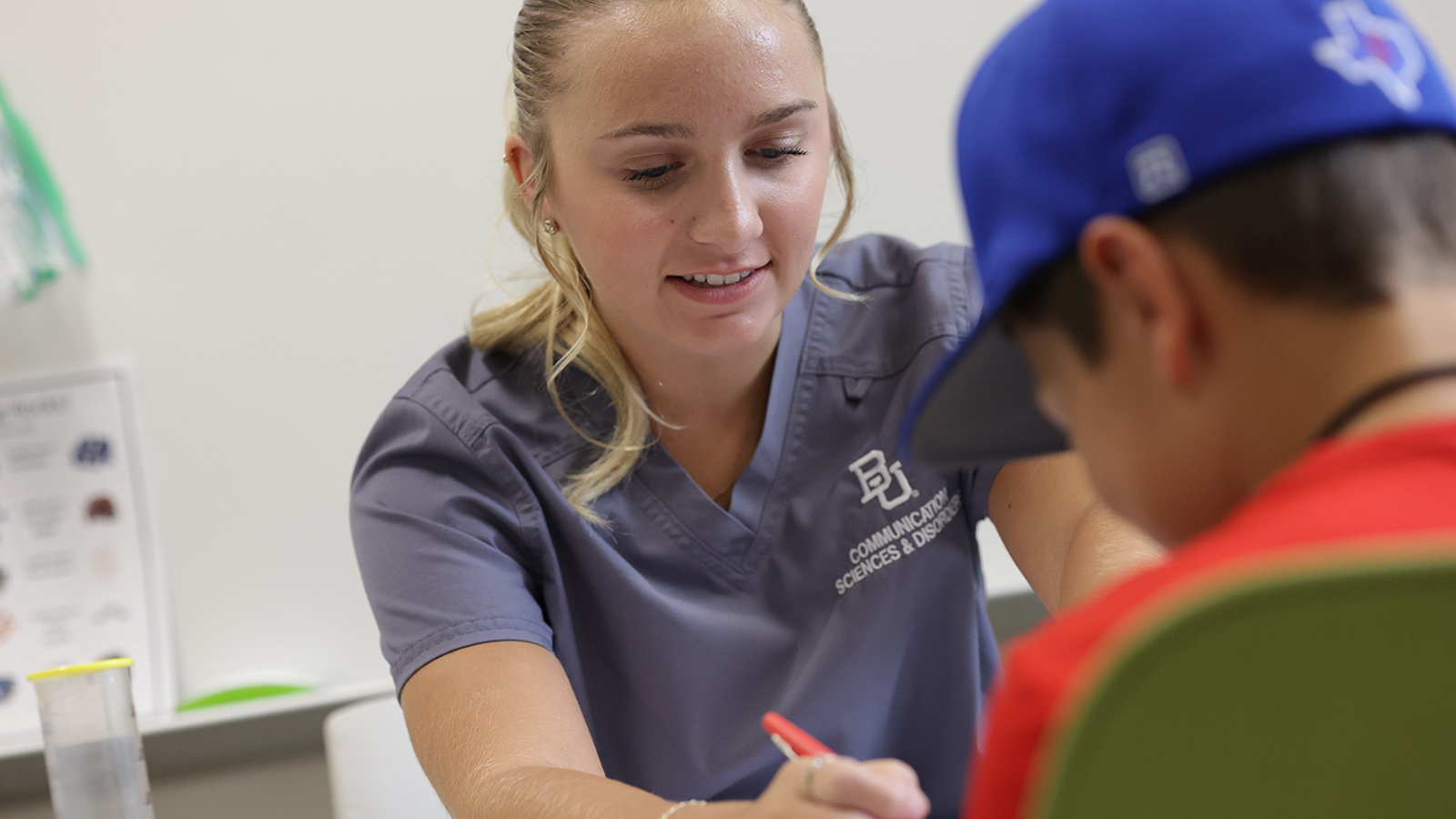
When Baylor University touts offering a “transformational undergraduate educational experience,” the Department of Communication Sciences and Disorders (CSD) might just serve as the ultimate paradigm.
Students who have selected the Bachelor of Science in Communication Sciences Disorders major are typically pursuing a career in speech-language pathology or audiology. These highly service-oriented healthcare professions require more than a textbook and lecture education. Through Baylor’s program, CSD students are offered and pursue numerous opportunities to enhance their learning beyond the classroom—benefitting not just their own professional development, but also their fellow classmates, the Waco community, and those in need around the world.
Clinical Training
To become a licensed and certified Speech-Language Pathologist or Audiologist requires a graduate degree, which means students pursuing these career paths typically spend their undergraduate years building a foundation of knowledge in the classroom before entering the clinic once they begin graduate school. Baylor undergraduate CSD students, however, have multiple opportunities to practice and serve in the clinic before ever submitting their graduate school applications.
The Baylor Speech-Language and Hearing Clinic is the hub for CSD clinical training. The Clinic provides comprehensive evaluation and treatment for patients of all ages in the Waco community experiencing difficulties such as disorders or delays in language or literacy, speech sounds, voice, fluency, cognition swallowing or feeding, social-pragmatics, augmentative and alternative communication (AAC), and hearing. Baylor clinical faculty provide high quality care while also teaching and mentoring graduate student clinicians.
Undergraduate CSD students have opportunities to serve alongside the faculty and graduate students in the Clinic. By becoming Undergraduate Student Clinicians, students receive special training through weekly classes and conferences that equips them to successfully work with clients. Students can also become Literacy Assistants who work directly with clients in the Baylor Language and Literacy Clinic or at Camp Success, the clinic’s intensive summer language and literacy intervention program. These undergraduate students receive training in a variety of multisensory language strategies for facilitating literacy skills.
“Serving as a Literacy Assistant has been an incredibly rewarding experience that complemented my academic studies with meaningful, hands-on application,” shared senior Emma Kay Clay. “Each week, I had the opportunity to build relationships with clients, support their growth in reading and language, and witness the direct impact of consistent, individualized encouragement. This role strengthened my communication skills, deepened my understanding of language development, and affirmed my passion for speech-language pathology.”
Undergraduate CSD students eager to dip their toes into clinical practice are not just limited to serving the Waco community. Students who choose to study abroad in Kigali, Rwanda, have the opportunity to explore the connections between cultural background and development of speech and language. These students also provide literacy, AAC, feeding/swallowing, and language assessments and treatment for local children, as well as education and child development training for mothers and caretakers.
“My study abroad experience in Rwanda was an incredible opportunity to gain hands-on clinical experience by working in a local daycare. I was able to connect classroom learning to real-life situations, which deepened both my understanding of and love for the field of speech-language pathology,” said Alexa Mehra, an alumna of the undergraduate program and now enrolled in the graduate program. “As we explored Rwanda’s unique and rich culture, I gained a deeper awareness of how cultural values and communication styles influence development. The lessons I learned there have continued to shape my perspective in graduate school at Baylor and will help me become a more culturally responsive and compassionate clinician.”
Research Experience
Hands-on training is not limited to clinical experiences for Baylor CSD undergraduates. Students also have the opportunity to serve as Research Assistants with CSD faculty. In this role, students participate in activities such as collecting and analyzing data, searching and reviewing literature, soliciting research participants, and other vital research project tasks.
Faculty research interests range from language development and disorders to cochlear implants to neurocognitive deteriorations and everything in between, giving students the opportunity to participate in research that matches their own interests. Whether a student intends to pursue research as a career or not, the experience working in a lab alongside research faculty offers multiple benefits, including a deeper understanding of the communication sciences and disorders field and the development of critical thinking skills.
“Under the mentorship of Dr. Yang-Soo Yoon, I was able to expand my understanding of the field of Communication Sciences and Disorders by reading peer-reviewed articles, presenting findings, and participating in lab discussions. This experience strengthened my critical thinking, enhanced my scientific literacy, and gave me meaningful insight into the research process,” shared alumna Maddie Arsenault of her experience as a Research Assistant. “I am incredibly grateful for this opportunity, as it has helped prepare me for a future career as a speech-language pathologist in both clinical and research settings.”
Leadership Development
True to the Baylor mission, not only are CSD undergraduate students equipped for service through these hands-on experiences, but they are also shaped and nurtured as leaders.
Baylor offers a robust National Student Speech Language and Hearing Association (NSSLHA), the national student organization of the American Speech-Language-Hearing Association (ASHA). By participating in NSSLHA, undergraduate students build connections and develop professionally through service events, advocacy, and monthly guest speakers.
In addition to participation in NSSLHA, undergraduates also have the opportunity to serve as CSD Ambassadors or CSD Mentors. Ambassadors act as representatives of the Department, helping with recruitment events, assisting with prospective student and donor tours, and participating in retention and engagement initiatives. Mentors must be in at least their sophomore year, as serve as mentors to new CSD students, helping them get connected with the department and oriented within their academic program.
“Being an Ambassador has caused me to grow immensely in all aspects of my life,” shared senior Regina Orozco. “It has allowed me to gain more confidence in myself and in my abilities. I have had the opportunity to meet a wide variety of people and participate in multiple events.”
Leadership programs like the Ambassadors and Mentors are merely the formal iterations of numerous unofficial leadership opportunities for CSD undergraduate students. Through all of these experiences—clinical, research, and leadership—this group of Baylor undergraduates is being formed in thoughtful, comprehensive ways to make an impact in the field of communication sciences and disorders, both now and into the future.
ABOUT ROBBINS COLLEGE OF HEALTH AND HUMAN SCIENCES AT BAYLOR UNIVERSITY
Established in 2014, Robbins College of Health and Human Sciences seeks to enhance health, quality of life, and human flourishing for all individuals and communities through education, research, and innovation. It includes six academic departments—Communication Sciences and Disorders; Health, Human Performance, and Recreation; Human Sciences and Design; Occupational Therapy; Physical Therapy; and Public Health—along with the Division of Health Professions, which houses the Master of Physician Assistant Studies program. Robbins College offers 13 bachelor’s degrees, eight master’s degrees, and six doctoral degrees, as well as nine graduate programs in partnership with the U.S. Army. Graduate programs in Robbins College are offered in a variety of modalities, including on campus, online, and hybrid.