

Reshaping Perspective on Healthcare Delivery
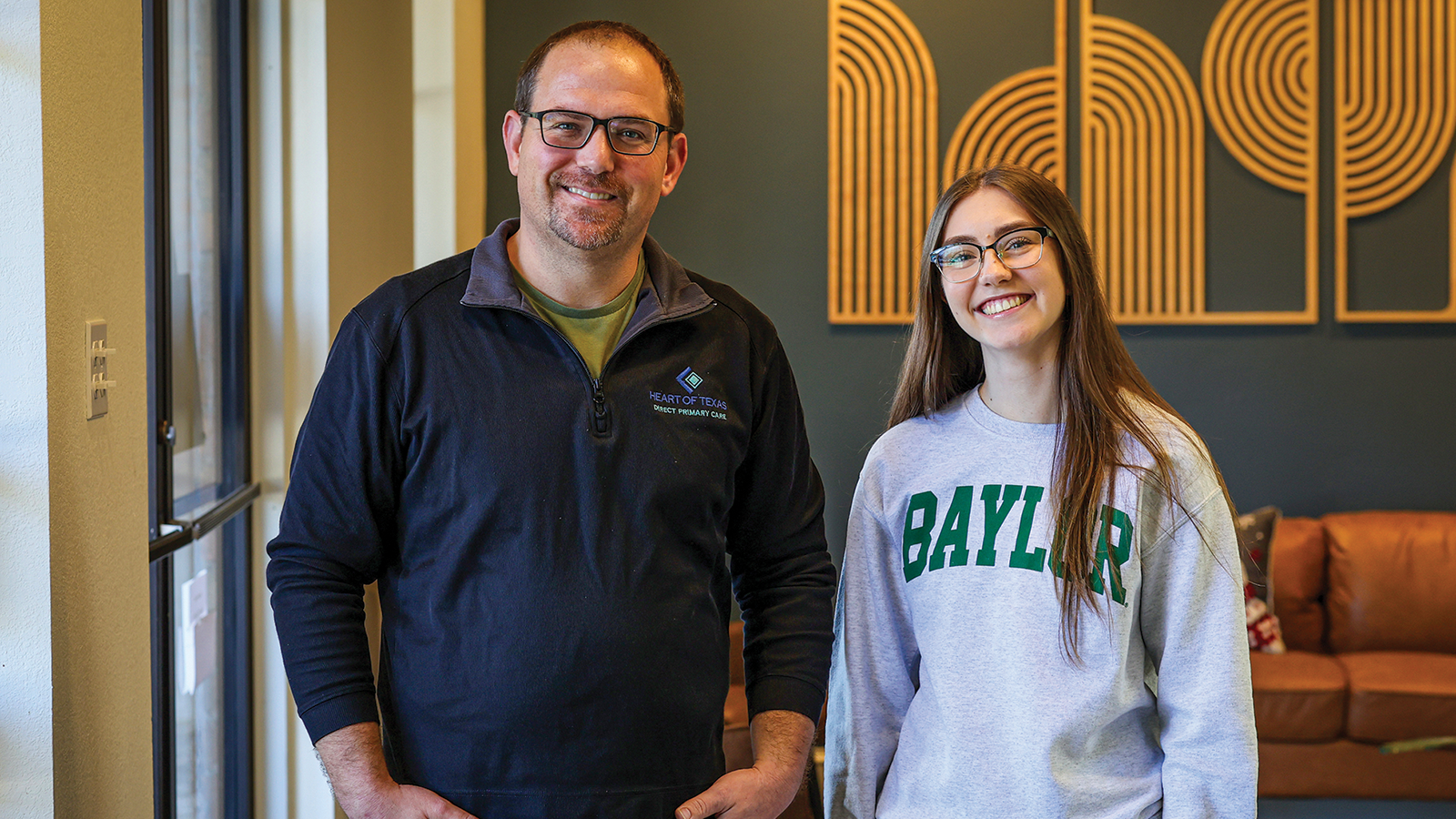
Internships play a critical role for students to gain hands-on experience in their chosen profession—and sometimes, they bring about unexpected moments that spark new perspectives. This was true for Health Science Studies senior Rubina Ramirez, who recently completed an “eye-opening opportunity” through the Department of Health, Human Performance, and Recreation’s (HHPR) Direct Primary Care Immersion Experience program.
With aspirations to become an OB-GYN and having already shadowed doctors in hospital settings, Ramirez was intrigued by the concept of direct primary care (DPC). She thought the internship—offered as one of six Health Science Studies Signature Experiences—might give her the chance to explore a completely different side of healthcare. As a membership-based healthcare model, DPC patients pay a monthly, quarterly, or annual fee directly to their provider, which grants them unlimited access to comprehensive primary care. By bypassing traditional insurance companies, DPC creates financial transparency and often allows for affordable rates.
During her internship, Ramirez worked directly with Trevin Rube, APRN, FNP-C, Family Nurse Practitioner and Baylor University alumnus, in his own membership-based clinic, Heart of Texas Direct Primary Care, in Waco. She found the most impactful aspect was being able to observe patient interactions and noted a significant contrast between standard healthcare experiences and the approach at the clinic.
“In most typical doctor’s offices, you might not even see your doctor for a 10-minute visit. That short interaction may leave you with a sense of being rushed, and it’s most likely because of the number of patients your doctor is scheduled to see that day, or perhaps care is limited due to insurance compliance,” she explained. “Here, our appointments can last an hour—or more. Mr. Rube takes the time to thoroughly explain diagnoses, treatments, and medication choices to his patients.”
This focus on patient education and communication reshaped Ramirez’s own perspective, and she is excited to contribute to shaping a future where healthcare feels personal and accessible to everyone.
“There is a profound impact in treating the whole person, not just their current symptoms. Healthcare shouldn’t just be about efficiency or profitability—it’s about truly understanding and addressing the patient’s needs,” she said. “Respect and empathy are critical for building trust, and I’ll carry that forward into my future career.”
“Baylor stood out to me because of its strong traditions and the effort it puts into creating a welcoming environment. I felt an immediate connection when I visited campus—I could see myself thriving here, not only academically but also socially.”
Rubina Ramirez
Ramirez has always been passionate about addressing the need for improvement in women’s healthcare, and the internship only encouraged her enthusiasm.
“So many women have expressed negative feelings about their experiences in the United States’ healthcare system,” she said. “I hope to be part of the change by creating a better environment for women when they see a provider. I’m fascinated by the complexity of women’s bodies and the incredible process of creating life and bringing it into the world.”
Her choice to attend Baylor was driven by the University’s stellar reputation for pre-medical education and its supportive community. Also, Ramirez was inspired by her former dance coach, a Baylor alumna, who often shared her love for the University.
“Baylor stood out to me because of its strong traditions and the effort it puts into creating a welcoming environment,” she recalled. “I felt an immediate connection when I visited campus—I could see myself thriving here, not only academically but also socially.”
HHPR’s Health Science Studies pre-medical track is demanding—with internship requirements—but Ramirez knows this rigor will help her reach professional goals. In addition, she joined Baylor’s only pre-health professional honor society, Alpha Epsilon Delta (AED), which underscores the value of community in achieving success.
“Baylor’s approach fosters collaboration over competition,” she said. “Through organizations like AED, I’ve gained insight into navigating the challenges of pre-med life, while forming meaningful connections with peers who share the same goals. This sense of community will undoubtedly carry into my career, where high-quality care depends on a team effort.”
Reflecting on her time at Baylor, Ramirez expressed gratitude for the opportunity to witness a new and evolving healthcare model that prioritizes relationships and holistic care. The HHPR internship experience, as well as her academic preparation, recently helped her achieve another milestone—acceptance into the University of Texas Rio Grande Valley School of Medicine. Ramirez is especially excited for this opportunity because it means she will have the opportunity to give back to the people living in her hometown as she pursues her medical degree and advocates for a companionate, patient-centered health approach.
ABOUT ROBBINS COLLEGE OF HEALTH AND HUMAN SCIENCES AT BAYLOR UNIVERSITY
Established in 2014, Robbins College of Health and Human Sciences seeks to enhance health, quality of life, and human flourishing for all individuals and communities through education, research, and innovation. It includes six academic departments—Communication Sciences and Disorders; Health, Human Performance, and Recreation; Human Sciences and Design; Occupational Therapy; Physical Therapy; and Public Health—along with the Division of Health Professions, which houses the Master of Physician Assistant Studies program. Robbins College offers 13 bachelor’s degrees, eight master’s degrees, and six doctoral degrees, as well as nine graduate programs in partnership with the U.S. Army. Graduate programs in Robbins College are offered in a variety of modalities, including on campus, online, and hybrid.