

More Than a Minor: ASL’s Real-World Career Impact
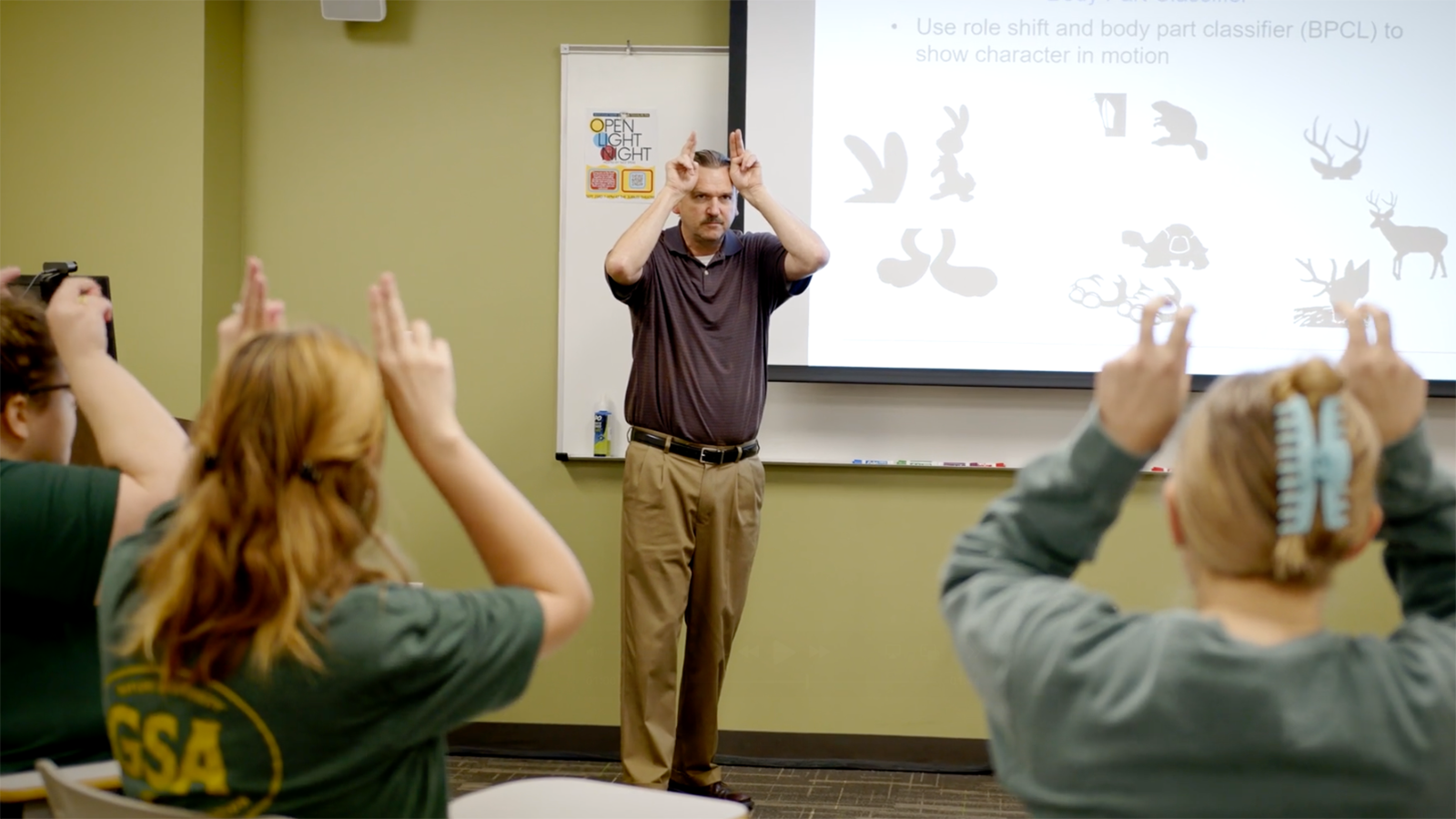
Larry Umberger from Baylor's Department of Communication Sciences and Disorders teaches an American Sign Language Course.
When Baylor University students enroll in American Sign Language (ASL) courses through the Department of Communication Sciences and Disorders (CSD), they learn more than just a new language and culture—the experience transforms how they think, communicate, and engage with the world. Along with deepening their understanding of the Deaf community, ASL equips students with versatile skills that prepare them for their future careers.
“ASL is really unique in opening students’ minds to a different way of communicating,” Senior Lecturer Marnie Abrahams explained. “It’s not just a different language; it’s a whole different mode of language.”
According to Lewis Lummer, EdD, CT, CDI, CS, CM, CII, CASLPI/R/T, CSCPI/R/T, Senior Lecturer and Baylor’s first known Deaf professor, many students who come to Baylor have misconceptions about ASL, like that it is direct communication in English through hand signs. However, ASL is its own language with different grammar, rules, and vocabulary from English. It is also not universally used. Many countries and cultures around the world use their own distinct sign language.
Lummer added that ASL also helps students build advanced critical thinking, complex cognitive skills, and stronger overall linguistic abilities. Unlike spoken languages, ASL is tactical, visual-spatial, and three-dimensional. Through learning ASL, students improve their spatial awareness, facial expression control, and directional thinking.
ASL is increasingly popular among students outside the Communication Sciences and Disorders major. Abrahams notes that in some classes, more than half the students come from other disciplines, ranging from nursing and social work to theater and ministry. American Sign Language courses count as a language credit in Robbins College of Health and Human Sciences and in most other colleges at Baylor. Students with a strong interest in the language can choose to pursue the ASL minor, which builds skills in ASL communication, linguistics, literature and arts, and Deaf culture.
“We’ve had theater students who want to work in Deaf theaters, nurses who want to communicate with Deaf patients, and social work students who see a real need for therapists fluent in ASL,” Abrahams said.
Lummer echoes this interdisciplinary appeal, sharing that students from biology, anthropology, psychology, religion, nursing, and even aviation sciences have thrived in ASL courses. He believes experience with ASL, rather than spoken foreign language, can significantly help when seeking employment.
He added that ASL is especially relevant in science and health-related fields, where professionals often work with people who use ASL or whose primary language is not English.
Daniel, who plans to pursue a career in health as a clinical ethicist or in policy, believes ASL is valuable in any field.
“Deaf people are all around us! When you can advocate for, connect with, and understand the needs of this community, you can find ways to speak up and use this skill in any setting or profession,” Daniel emphasized.
She has already used ASL professionally, once while working at an ice cream shop and once while hosting at a restaurant.
“Both times I was able to connect with the customers in a more natural way because there wasn’t a language barrier,” Daniel said.
For Matthew Jalilie, a senior Aviation Science major, learning kinesthetical movements, a key component of ASL, made him more observant.
“It’s crucial to pick up on smaller details when signing, especially with Deaf individuals,” Jalilie said.
He’s also found that ASL’s descriptive nature has strengthened his storytelling skills. What he learned in the American Sign Language III course helped him bring more vivid detail into his creative writing.
Joleen Gould, a senior Social Work major, discovered that communication in ASL extends far beyond learning new signs.
“You can communicate in many other ways besides using your words—and not just with your hands,” Gould shared. “You can communicate with your body language, facial expressions, and so much more.”
For Miriam Daniel, a junior Medical Humanities major with ASL and Sociology minors, ASL offers a deeper form of communication that spoken language can’t imitate.
“So many ASL signs convey meanings that simply don’t have words to match,” Daniel explained. “When I’m signing, I feel like I can express emotion, tell stories, and understand the feelings of my peers in a depth that English does not allow.”
ASL coursework at Baylor extends far beyond language instruction. It also educates students about Deaf culture, art, and literature. This foundation equips them to engage meaningfully with the Deaf community by attending cultural events, supporting Deaf-owned businesses, and experiencing theater performed in ASL. Through this cultural exposure, students develop a deeper sense of empathy and a heightened awareness of systemic inequities.
“Students are learning about allyship, access, and privilege,” Abrahams said. “They’re thinking about perspectives they hadn’t considered before.”
According to Harvard Business Review, soft skills like empathy, communication, and cultural awareness aren’t just socially valuable, they’re increasingly prized in the workplace. Research shows these foundational skills are stronger predictors of long-term career success than technical expertise.
Jalilie, Gould, and Daniel encourage their peers to take ASL at Baylor if they have the opportunity.
“The teachers for ASL are amazing, especially if you have Dr. Lummer or Mr. Umberger. I have learned so much from having a native signer teach me ASL. When I first decided to take ASL, it was only for fun, but after my first semester, I was hooked. The culture associated with the language is amazing,” Jalilie said.
“ASL is such a beautiful language, and the Deaf culture is so interesting and expansive. I believe everyone should learn ASL because it’s helpful to know and fun to communicate in a nonverbal language,” Gould said.
“Baylor ASL has been such a gift to me. Each professor genuinely cares and wants their students to succeed,” Daniel added. “I could not be more grateful for the way ASL at Baylor has impacted my college experience.”
ABOUT ROBBINS COLLEGE OF HEALTH AND HUMAN SCIENCES AT BAYLOR UNIVERSITY
Established in 2014, Robbins College of Health and Human Sciences seeks to enhance health, quality of life, and human flourishing for all individuals and communities through education, research, and innovation. It includes six academic departments—Communication Sciences and Disorders; Health, Human Performance, and Recreation; Human Sciences and Design; Occupational Therapy; Physical Therapy; and Public Health—along with the Division of Health Professions, which houses the Master of Physician Assistant Studies program. Robbins College offers 13 bachelor’s degrees, eight master’s degrees, and six doctoral degrees, as well as nine graduate programs in partnership with the U.S. Army. Graduate programs in Robbins College are offered in a variety of modalities, including on campus, online, and hybrid.