

Meet Baylor's First Pediatric Physical Therapy Resident
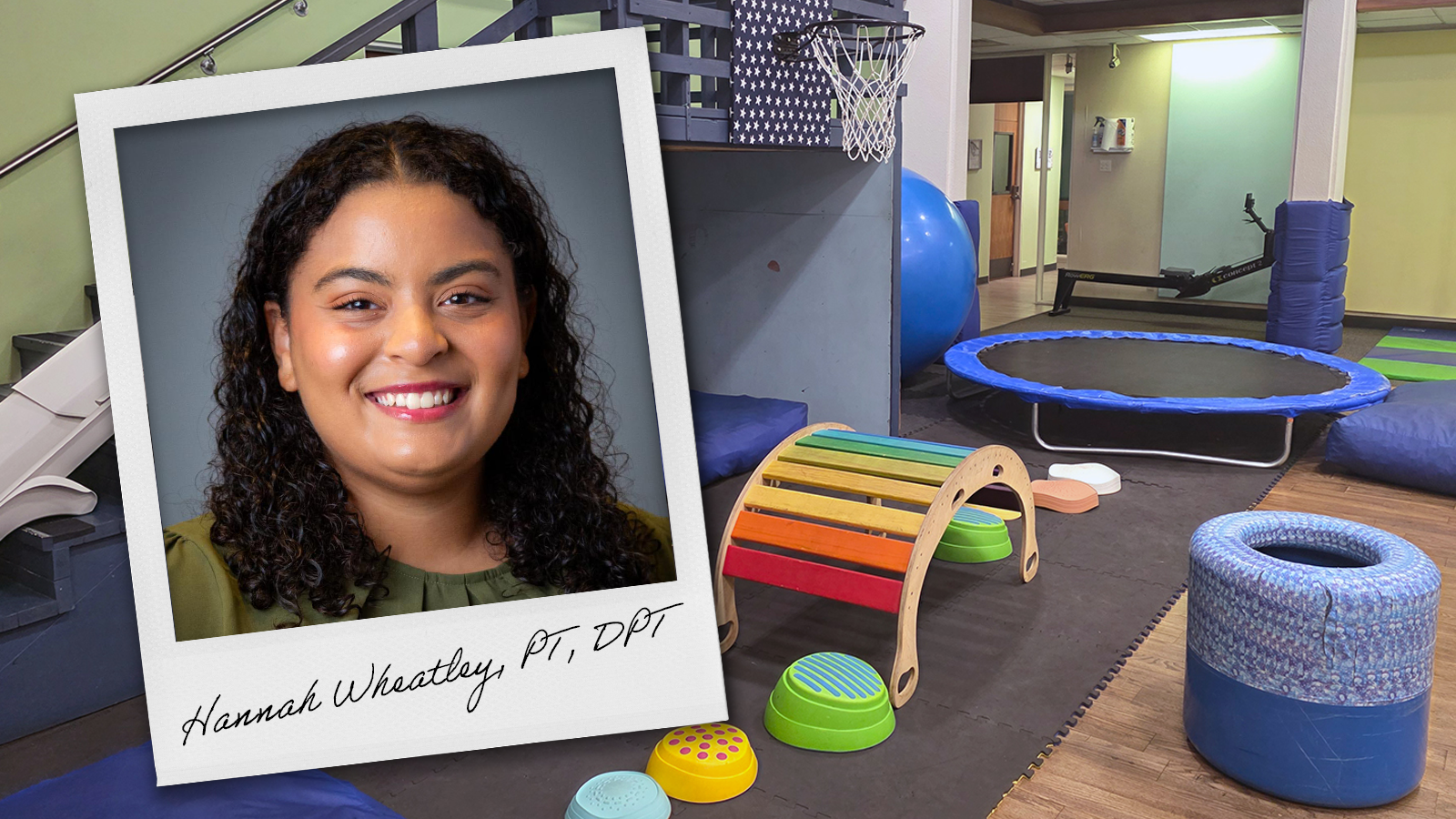
Hannah Wheatley, PT, DPT, has always been fascinated by movement. A competitive dancer for 11 years, she knew she wanted a career that kept her active or helped others stay active. Her love for working with children grew through experiences in church ministry and as an assistant dance teacher. When her own family members benefited from physical therapy, Wheatley was inspired to pursue this profession, specializing in pediatrics.
“Every road led me to physical therapy,” Wheatley said.
Her calling brought her to Baylor University’s Doctor of Physical Therapy (DPT) program, from which she graduated in December 2024. Next, she began exploring residency opportunities.
While residencies are optional upon obtaining licensure, they give physical therapists the opportunity to gain specialized experience more quickly and can support eligibility for board certification. Baylor’s two-year DPT program also makes adding a residency year more feasible compared to traditional three-year programs. Fewer than 10% of physical therapy graduates currently pursue residencies, but that number is steadily growing as more therapists look to enter specialized fields such as pediatrics.
“There are many pediatric practices that want you to have experience before you start,” Casey Unverzagt, DPT, DSc, Director of Residency Education, explained. “A residency almost fast-tracks that experience for you—we often say it’s like gaining five years of specialty experience in one year.”
After evaluating her options, Wheatley chose to pursue Baylor’s new Pediatric Physical Therapy Residency, becoming its inaugural resident in June 2025. She was drawn again to Baylor for the breadth of clinical experiences—residents rotate through hospital, outpatient, and school-based settings—as well as the opportunity to teach as an adjunct faculty member in the DPT program. She believed this combination would best prepare her to serve her patients as a clinician and prepare her for teaching in the future.
“I have always been the kind of person who wants to become an expert in whatever I’m doing,” Wheatley said. “Pediatrics is a population where you have to be an advocate. I wanted to make sure I had the tools and knowledge so that when I work with kids, I’ll be fully prepared.”
The Baylor residency is a partnership with Hope and Believe Pediatric Therapy, a Waco-based clinic that combines expert care with a mission rooted in faith and service. Baylor oversees the didactic portion of the program, while the residents complete the majority of their clinical hours treating patients at Hope and Believe.
“It made sense to partner with a local facility with a similar mission, vision, and values as we have,” Unverzagt said, noting the clinic’s emphasis on Christ-centered care.
Along with outpatient therapy experience at Hope and Believe, residents rotate through inpatient therapy, early childhood education, and school-based therapy settings in the Waco-Temple area.
A Day in the Life
At this point in her program experience, Wheatley has completed the inpatient therapy rotation at Baylor Scott & White McLane Children’s Hospital and is now working in outpatient care at Hope and Believe. By 8:30am each morning, she is at the clinic, ready to welcome her first patient of the day. Her schedule might include co-treating alongside a mentor, observing a mentor’s session, or leading a session herself with her mentor observing. For Wheatley, the mentorship has been the most valuable aspect of the program.
“You don’t always have someone next to you who knows the answers to your questions,” Wheatley said. “However, in Baylor’s residency, I know that if I want to be able to provide this for my patient, I have the resources to help me. That support helps me connect the dots and apply what I’m learning.”
Much of pediatric physical therapy is learning to collaborate with occupational therapists and speech-language pathologists, working together to create holistic treatment plans for young patients. Wheatley’s training has also included advanced evaluation techniques and practical tools such as orthotics in addition to practicing her ability to communicate with children and their families. For example, many of her sessions include exercises disguised as games.
“With kids, you have to meet them where they’re at. I don’t ask, ‘Are you fatigued?’ Instead, I ask, ‘Are you sleepy?’ Wheatley explained. “A kid doesn’t want to go to therapy and do 10 Bosu squats, so I’ll incorporate a game, like cornhole, where we squat down to pick up the sandbags and throw them. I’ve used Nerf guns, set up obstacle courses—for kids, it feels just like playing and having a great time.”
Her days typically extend into the late afternoon, balancing patient care with mentoring hours. Evenings are often spent preparing for weekly topics, reviewing research articles, joining virtual mentor sessions, or attending educational meetings with residents nationwide through the American Physical Therapy Association’s Pediatrics Residency and Fellowship Consortium. Her virtual mentor calls, called “sync sessions,” give her an opportunity to reflect on challenges and share progress.
Looking Forward
While this is the Baylor program’s first year, Unverzagt hopes to see it expand to enrich two residents in the future, furthering Robbins College of Health and Human Sciences mission to prepare servant-leaders who improve health and quality of life across all populations—so the youngest among us can grow, play, and thrive.
For Wheatley, each patient she meets is a reminder of why she chose this path.
“I feel like this is the path God has set me on,” Wheatley said. “For me, it’s bigger than just my profession. This is something that I feel very strongly called to, and I want to do it well.”
ABOUT ROBBINS COLLEGE OF HEALTH AND HUMAN SCIENCES AT BAYLOR UNIVERSITY
Established in 2014, Robbins College of Health and Human Sciences seeks to enhance health, quality of life, and human flourishing for all individuals and communities through education, research, and innovation. It includes six academic departments—Communication Sciences and Disorders; Health, Human Performance, and Recreation; Human Sciences and Design; Occupational Therapy; Physical Therapy; and Public Health—along with the Division of Health Professions, which houses the Master of Physician Assistant Studies program. Robbins College offers 13 bachelor’s degrees, eight master’s degrees, and six doctoral degrees, as well as nine graduate programs in partnership with the U.S. Army. Graduate programs in Robbins College are offered in a variety of modalities, including on campus, online, and hybrid.