

Evaluating Cameron Park Zoo Through an Occupational Therapy Lens
Home to more than 1,700 animals, Cameron Park Zoo resides on 52 acres in Waco, Texas. The environment encompasses hills, native plants, and waterfalls. Play areas and a splash pad have been designed for children to play, a nursing pod is available for mothers, and educational signage is posted throughout exhibits to promote conservation awareness.
Each year, more than 300,000 visitors pass through its entrance—making Cameron Park Zoo the second-most visited attraction in town—and with so many guests passing through its gates, the zoo is striving to become more inclusive.
A Budding Long-Term Collaboration
The Cameron Park Zoological & Botanical Society, which serves as a nonprofit “fundraising arm” to envision, fund, and promote programs, is playing an important role in turning this accessibility and inclusiveness initiative into a reality—and to do so, it enlisted the expertise of Baylor University’s Department of Occupational Therapy.
Morgan Snyder, occupational therapist and current board member of the zoo, knew examining the zoo through an occupational therapy lens could be uniquely successful, so she reached out to Clinical Associate Professor Kaitlyn Cremer, OTD, MOT, OTR, SCLV, CAPS. The two began to develop a plan, ultimately expanding the reach of their profession into spaces not traditionally seen.
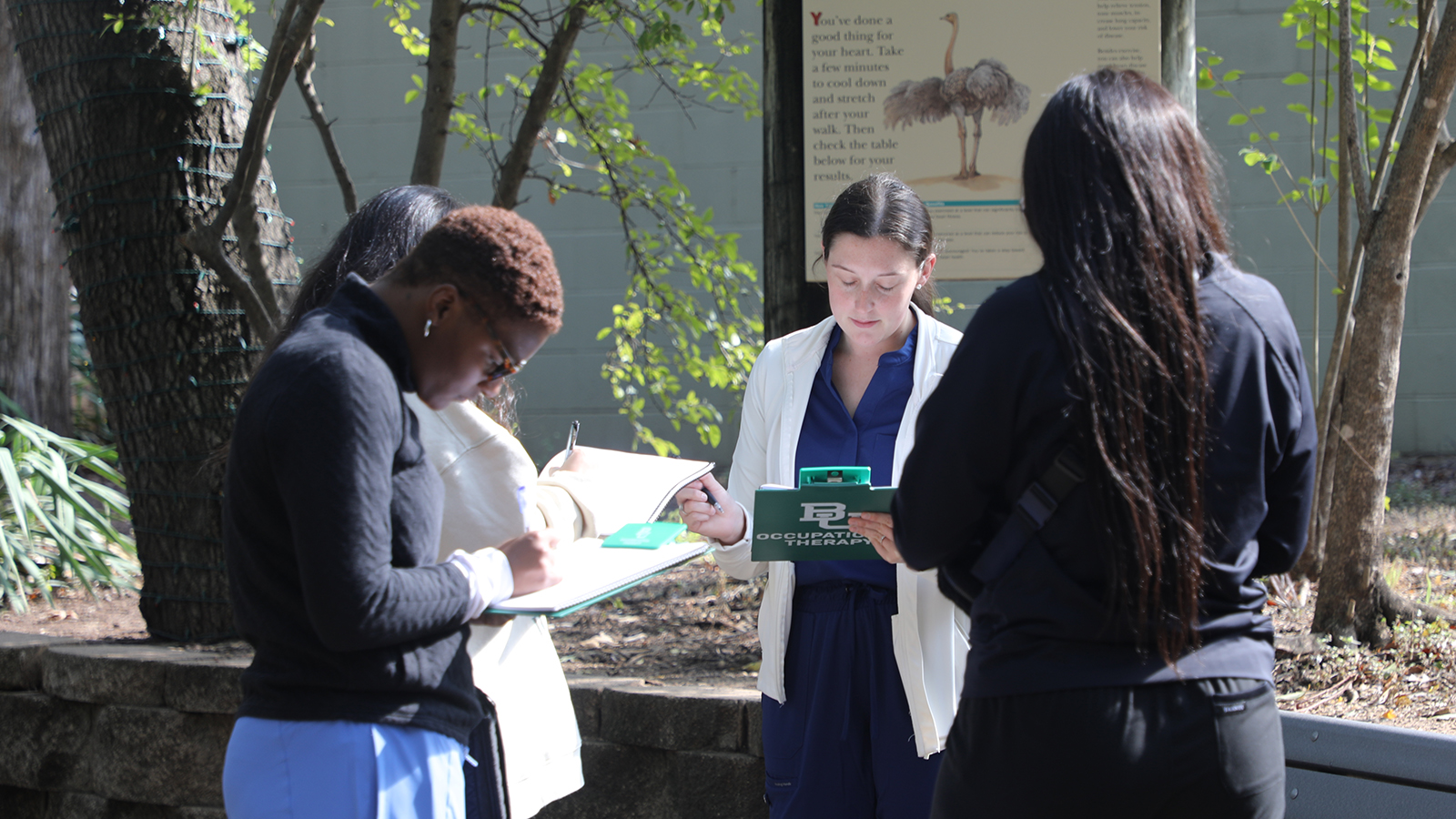
In Fall 2024, as part of their lab immersion experience, Baylor Doctor of Occupational Therapy (OTD) students performed an accessibility study of the zoo. They evaluated doors, pathways, restrooms, signage, and sounds—anything to gain a deeper understanding of the environment. To start, students were each assigned a different health condition, like autism, diabetes, spinal cord injury, and low vision. Then, they were tasked to evaluate from that perspective as they experienced the area. Finally, they reported feedback, each identifying three barriers and suggesting three corresponding solutions.
“This will help us adjust so that we aren’t excluding individuals or making it more difficult for individuals to engage because we don’t have something already in place,” Kristi Webb, Executive Director of Cameron Park Zoological & Botanical Society, said. “For example, our pathways were all built to ADA standards, but in reality, some of our pathways are a little narrow now and we also have a lot of hills—so we appreciate Baylor coming at it from the perspective of, ‘Okay, yes, it meets the standard, but is it truly accessible?’ We want to find that gray area and adjust where we can.”
Expanding further, and under the mentorship of Cremer, OTD students Emilee Morgan and Kaitlyn Setliff will collaborate with the zoo for their required doctoral capstone projects. So far, they have each completed their literature review, to ensure everything they plan to work on is supported by evidence. While very much in the beginning phases of planning, they intend to utilize visitor surveys and focus groups to gain perspectives from individuals who frequent the zoo. In Fall 2025, Morgan and Setliff will begin to implement their evidence-based programs.
Environmental Modifications for Increased Inclusion
For her project, Morgan desires to move Cameron Park Zoo’s environment beyond being simply ADA compliant and aims to design elements that will provide further accessibility. Through exploration, she learned many zoos across the country have already started this process, which aids in developing her blueprint of the steps she’ll need to take. She plans to first implement surveys to gather lived experience information to further inform her project.
Designing a sensory walk along the current nature trail is her main goal. While still considering how the walk will look, Morgan will add tactile pieces that children and adults alike can touch and feel as they walk. For an individual who may be overwhelmed, focusing on and being in full control of touching these elements can help them to block out outside irritants. She also plans to build a sensory space, which would provide a calming area for individuals who might need quieter spaces to help calm the nervous system when in overdrive.
“I’ve grown up in Waco, so the zoo was a place that I went to a lot. I thought it would be a meaningful opportunity to give back to a space in my own community,” Morgan said. “I know that a lot of times capstones are done in traditional treatment environments, like a hospital or clinic, but I’m excited to be embedded in my community. This is a big part of what occupational therapy is—community mobility, accessing your environment, and feeling included in the social aspect of it. This experience will set me up well for advocating for clients, ensuring equitable experiences in an environment, and carrying that awareness into future practice.”
Calming Resources
A zoo environment can have loud, unexpected noises—from animals, auditory opportunities at exhibits, and people—and often, it can be very crowded with long lines. For many individuals with autism spectrum disorder, attention deficit hyperactivity disorder (ADHD), or sensory processing disorder, the atmosphere can quickly cause over stimulation. For her project, Setliff wants to help address such needs for these young visitors.
While she is particularly interested in the pediatric population, the updates she plans to make could benefit individuals of all ages. Setliff plans to update Cameron Park Zoo’s sensory kits so they will target more sensory systems to help visitors fully engage. Currently, these kits provide visitors resources like fidget toys and headphones for noise, so Setliff plans to add a QR code so guardians can answer a quick questionnaire about all included items. Using those results and evidence, she will update and enhance the kits.
“I’m hoping it will make a difference in the lives of either the kids who are using the sensory kits or the parents who are attending the zoo with their kids,” Setliff said. “Hopefully, we can make their experience more functional, so they’ll be able to participate fully in everything that they want to do while they’re here.”
In addition, Setliff plans to train staff on how to best communicate and interact with individuals on the spectrum. She will also inform of ways to address if guests are showing signs of dysregulation.
She hopes her capstone experience in a zoo environment will provide a new perspective of the occupational therapy profession and show a different side of what practitioners can do to serve those in their own community.
“Occupational therapy is truly such a diverse field, and that’s why I love it,” Setliff said. “If you ever want to work in a different setting or learn more about a different condition, you can make that transition and it feels totally different—but it’s still the same career.”
What the Future Holds
All collaborators believe looking through an occupational therapy lens will help Cameron Park Zoo adjust to better fit the diverse needs of its guests. For example, signage throughout the zoo is currently only in one language, and a conversation was sparked on possibly updating it to be bilingual, including Braille elements, and have some sort of audio tour. One day they hope to design a sustainable sensory garden. Excitedly, this is just the start of potential long-term growth because additional Baylor programs, like engineering, have shown interest in joining the partnership.
“Ultimately, we want to make this a great experience for everyone who comes through our gates. We know that we have shortcomings—sometimes we forget to look at some of the more impactful things that we could be doing, and instead, we get caught up in what exhibit is next and what thing can we do to draw people here,” Webb said. “Sometimes, we just need to take a step back and look at who’s already coming and what we can do to make the experience better for them.”
ABOUT ROBBINS COLLEGE OF HEALTH AND HUMAN SCIENCES AT BAYLOR UNIVERSITY
Established in 2014, Robbins College of Health and Human Sciences seeks to enhance health, quality of life, and human flourishing for all individuals and communities through education, research, and innovation. It includes six academic departments—Communication Sciences and Disorders; Health, Human Performance, and Recreation; Human Sciences and Design; Occupational Therapy; Physical Therapy; and Public Health—along with the Division of Health Professions, which houses the Master of Physician Assistant Studies program. Robbins College offers 13 bachelor’s degrees, eight master’s degrees, and six doctoral degrees, as well as nine graduate programs in partnership with the U.S. Army. Graduate programs in Robbins College are offered in a variety of modalities, including on campus, online, and hybrid.